

Emmanuel Gelinotte, GPI’s global vice president of research and development, describes the company’s latest counterfeiter-thwarting security features
Gaming Partners International (GPI) has earned its position as the world’s leading provider of casino currency by tirelessly innovating to stay ahead of ever-resourceful counterfeiters.
GPI supplies chips, plaques and jetons under the well-known brand names Bourgogne et Grasset (B&G), Paulson and Bud Jones. The first of those brands to be established was B&G, and its raison d’être was, unsurprisingly, beating the would-be cheats.
In the 1920s in Beaune, in the Burgundy region of France, lithographer Etienne Bourgogne and engineer Claudius Grasset were working to pioneer the use of plastics for use in items such as brooches, hair slides and plastic playing cards. The partners were the first to master the art of plastic film printing. One day in 1925, Mr Grasset read in the newspaper Le Figaro that a player had broken the bank at the Monte Carlo Casino to the tune of 600,000 Francs using counterfeit chips made of solid ivory and mother of pearl.
Bourgogne and Grasset saw an opportunity to use their plastics research and their technical skills to address the counterfeiting problem. The partners got to work on producing a new generation of chips that would offer casinos total security. They perfected an ingenious process by which the impression of the chip was protected by a thin plastic film, which made it practically impossible to imitate them.
The partners sent some samples to the general manager of the Monte Carlo casino, Monsieur Blanc, whose reply came in the form of a chip order, and Bourgogne et Grasset was born as a gaming supplier.
For almost nine decades since then, GPI has helped casinos secure their currency. It helps that B&G is among a handful of brands with plaques and jetons made of laminated acetates. “There are not a lot of manufacturers in the world who use acetates,” reveals GPI Global VP of R&D Emmanuel Gelinotte. “We use a process very similar to that used to make credit cards. However, while credit cards are usually made of PVC, we use acetates. It’s actually very difficult to laminate acetate sheets, but back in 1923, Bourgogne et Grasset developed an intricate process to laminate acetate sheets that is a significant trade secret of our company. This process hasn’t changed much over the years, and is one of the reasons our plaques and jetons are so secure.”
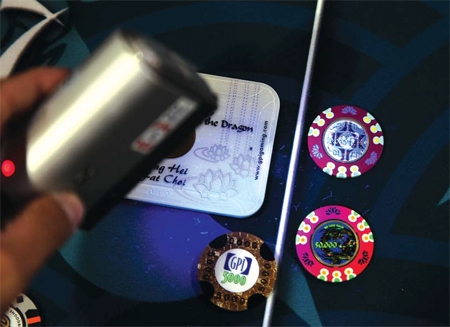
At this year’s G2E Asia, held in May at the Venetian Macao, GPI showcased four new security features. The first is an innovative application of ultraviolet security protection the company calls UV-4C, which entails using a standard UV detector to reveal a unique full-color photo or image hidden in the chip decal.
“Regular UV has been around for years and years,” observes Mr Gelinotte. “And, because it’s used by so many industries for so many applications, it’s not as strong a security feature—you can even buy UV pigment on the internet. So 4C-UV is really unique: it uses multiple UV inks in a very advanced four-color process way to produce pictures or intricate multi-color designs that can still be detected with a standard UV light. And, when it’s used on a gaming chip, a casino can have a series of multi-color logos, a unique photograph, or virtually any other multi- or four-color image that will be revealed when we shine the UV light on it, but will totally disappear when you switch off the light.”
“It’s a very new technology,” adds Mr Gelinotte. “You need specific software to do it, because you are working with invisible colors. Whereas with visible colors you know what to expect when you mix green with red, with invisible colors it’s a totally different story. So there is a very special software developed for that, and we have secured the exclusive rights to this cuttingedge technology within gaming.”
At G2E Asia, GPI also introduced its new holographic MicroDots—miniscule hologram particles that can be added to decal printing inks. Not only do MicroDots provide an “overt” security feature visible to the naked eye, they also offer a further “covert” Level 3 security feature that’s not visible and requires a magnification device for authentication. “You can see some metal particles here,” says Mr Gelinotte as he presents a chip with MicroDots embedded into the chip decal. “Seeing the metal particles tells you that they are there, and if you go to the next level of chip authentication you use a small microscope and you’ll see a real security hologram with a special code on it.”
MicroBeads are another brand new security feature, falling under the covert category. MicroBeads are added to chip decals and reveal a series of bright red beads, resembling “a starry night,” observes Mr Gelinotte. Using a proprietary device, MicroBead markings are easier to authenticate than micro-text, reducing the amount of time required to determine if a chip is real.
SecuriTagg offers one more covert Level 3 security feature, comprising a taggant that is revealed by a specialized hand-held tool. SecuriTagg also includes a unique identifier that can be forensically authenticated by a lab, providing an even higher level of authentication. “The taggant is a special chemical formulation based on different phosphors,” explains Mr Gelinotte.
GPI also took the occasion of G2E Asia to unveil two additions to its B&G currency line. The new B&G J2 Jeton is a hybrid combining the aesthetic and security features of traditional European-style jetons with the easy handling of an American-style chip. Among the hybrid’s other benefits, the company states: “B&G J2 jetons are easier to stack and handle than traditional jeton shapes, making them a more appealing solution for high chip volume table games. They also enable the use of a wider range of decal design options as well as a broader range of security features.”
Mr Gelinotte describes the thinking behind the hybrid jeton: “Our customers like jetons not just because they are visually appealing, but also because the materials like the gold laces or mother of pearls used to create them are also high security elements. But, jetons aren’t as easy to handle as American-style chips, which can be challenging for dealers and other staff. So we wanted to create a hybrid that combines the advantages of the jeton with the efficiencies of American-style chips. The B&G J2 Jeton is exactly the same profile and shape as an American-style chip with the same weight, but includes a label where we can have a hologram or any kind of security feature that is offered in our American-chip products.
“We also just released this year what we call B&G Premium Chips,” says Mr Gelinotte. According to the company, “B&G Premium Chips combine innovations in chip design, 3D injection mold design engineering and manufacturing with the industry’s largest selection of overt and covert security features to give casinos the ability to create completely custom chips. By incorporating a wide range of colors with up to six individual injections, casinos can create an intricate chip mold design that is both visually distinctive and unique as well as more counterfeit resistant.”
Mr Gelinotte adds: “The fact that we are doing unique molds is also better in terms of security because when you use chip molds from a menu it makes it easier for counterfeiters who could replicate that mold. With B&G Premium Chips, however, customers have their own unique set of molds featuring their own intricate designs, which makes it much more expensive and challenging for potential counterfeiters.”
B&G Premium Chips offer other possibilities, points out Mr Gelinotte. “The good thing as well of doing the premium customized chips is that we can fully use the products for branding purposes. We can include a casino’s logo on the chip, promote the property, and really distinguish it from its competitors.”
At G2E Asia 2012, GPI also highlighted two enhancements to its RFID portfolio:
• Chip Inventory System 2.0, which uses RFID technology to track the location and status of all enabled chips, helping operators increase inventory movement efficiency and security by tracking casino currency from the cage or vault to its authorized location on the gaming floor. CIS 2.0 can also be integrated with casino and table management systems for reporting and transaction data, eliminating the need for manual data entry.
RelatedPosts




• RFID Total Money Management, which combines the efficiencies of RFID with a high-speed table bill validator designed by JCM, streamlining table game cash and chip transactions to enable an increase in rounds per hour while providing increased currency security through instant authentication and validation.
GPI continues adopting the latest technology and inventing some of its own in the race to stay ahead of counterfeiters, while also striving to enhance its products’ aesthetic appeal and value as marketing tools.
Mr Gelinotte sums up what constitutes a secure chip: “It’s like the bank note industry: there is no miracle security feature. A secure solution is a combination of security features from different levels—Level 1 to Level 3—and of overt and covert features. So, a good chip, a secure chip, has security features from all levels and a balance of overt and covert features. That’s exactly what monetary authorities are doing for banknotes: they combine a mix of generally inexpensive security features to have a more secure note. With our gaming currency we apply the same approach, and just like the banking industry, we are constantly adding new features that can be used to replace a security feature when it is compromised or becomes too widespread.”