

As Indochina correspondent Rich Meyer reports, Entertainment Gaming Asia looks set to raise the bar for border casinos with its recently opened Dreamworld Pailin
The casinos at the Thai-Cambodia border have long been marginal operations. They are generally quite small and dingy, in poorly decorated and maintained buildings. Some sit in dusty no-man’s lands between the two countries—areas best known for duty-free dealings and itinerant workers. The legal underpinnings of the casinos are not always clear, and there’s a sense that some of the operations may not be totally aboveboard.
But now there’s an outfit seeking to change that perception. Entertainment Gaming Asia (EGT)—a Nevada-incorporated, Hong Kong-managed, New York Stock Exchange -listed company—has just opened a casino at Pailin, Cambodia, just across from a Thai checkpoint. EGT is out to set a new standard for the Asian border casino.
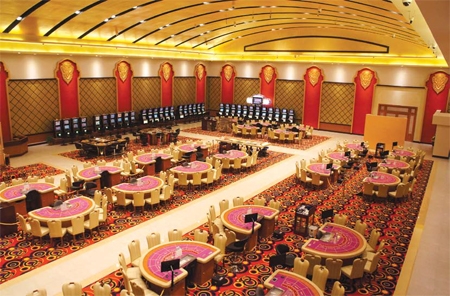
EGT’s Dreamworld Pailin opened in May. According to Clarence Chung, EGT’s chairman and chief executive officer, the operation currently has 26 tables and 50 electronic gaming machines. There are also two VIP rooms, with a total of four tables.
Grant Govertsen, an analyst at Union Gaming Research in Macau, visited Dreamworld Pailin and some of its local competitors and came away impressed. He said that the EGT casino is in a different league altogether from the nearby operations, most of which are dreary establishments with tattered carpets, low ceilings and few if any amenities. Dreamworld is more along the lines of a casino in a developed gaming market, with a large, open floor, professionallooking staff and well-maintained machines. While Mr Govertsen is not formally covering the company, he did issue an initial report with his observations. In the report, he describes Dreamworld as a “category killer,” overshadowing all the other border casinos in terms of quality and potential.
Quality construction comes reasonably cheap in Cambodia, with Dreamworld Pailin costing US$2.5 million to build. EGT pays a monthly rental of $5,000 for the property and keeps 80% of the operating profit, distributing the rest to its local partner. Mr Govertsen is optimistic about Dreamworld. He believes it sits in a great location, adding that despite the generally low-grade atmosphere of the neighborhood and the lack of upkeep at some of the other casinos in Pailin, they all seemed to be experiencing brisk traffic when he visited.
“During the time I was there—mid-day, mid-week—it was all but impossible to get on a table at any casino in the market. Such a high occupancy suggests that the market is likely under-supplied,” noted Mr Goversten.
EGT has plans for two more border casinos in Cambodia on the drawing board. The company is scheduled to open a casino in Poipet, a town north of Pailin, by the end of 2012. Poipet is the main land crossing between Cambodia and Thailand and is much better known than Pailin. Pailin is four hours by road from Bangkok, a city of 7 million people, while Poipet has better connections and can be reached in two hours from Bangkok. The Dreamworld in Poipet will be a US$7.5 million slots-only project. In this case, the landlord/partner will take 60% and EGT 40% of operating profit.
Also in the works is a casino at Kampot, near the Vietnam border. That project will look to draw customers from Ho Chi Minh City, Vietnam’s most populous city, which is less than five hours away by road. It has a construction budget of US$1.2 million, will include 25 tables and 40 machines, and should be up and running in 2013.
EGT’s strategy is very similar to NagaWorld’s, only it is getting quite a bit closer to the target markets of Thailand and Vietnam—the former prohibits casinos, while the latter restricts entry to foreigners. Proximity appears to be especially important when it comes to luring Thais. While NagaWorld’s efforts to market itself to players from Ho Chi Minh City are working well—it has dedicated coaches plying the route between the Vietnamese city and Phnom Penh—Thailand has proved more a challenge. The roads are not as good, the border crossing is less efficient and the distances are greater. EGT has stepped nicely into the breech by offering a service to Thais who may not want to travel so far by car or get on a plane.
The Cambodia casino market is thus developing in a bit of a hub-and-spoke manner. NagaWorld is at the center, the undisputed leader with critical mass and a highly sophisticated VIP program. And it is surrounded by smaller operations that take up the intermediate traffic. The markets are largely the same; it’s the scale and location that are different.
EGT got its start as a lessor of electronic gaming equipment. It is also a maker and seller of high-frequency RFID and traditional non-RFID gaming chips through its Dolphin Products subsidiary. As of March 2012, the company had 1,560 electronic gaming machines (EGM) in operation—799 in Cambodia and 761 in the Philippines. It has 670 EGMs at NagaWorld, where EGT gets 25% of the win per unit per day. It also has a contract for 250 machines at the Thansur Bokor Resort and Casino in the Bokor Mountains, Cambodia, where EGT will get 27% of the win per unit per day. At the end of 2011, 64% of the company’s consolidated revenues were from the EGM business.
By opening its own casinos in Cambodia, EGT not only retains a higher proportion of the revenue generated by its activities in the country, but it also insulates itself from the possibility of being dis-intermediated from its customers. The contract with NagaWorld is up in 2016, and it’s not clear whether that very big piece of business will be renewed, and at what rate. At the end of 2011, the EGMs at NagaWorld were 51% of the company’s consolidated revenues, according to the 2011 annual report.
“As of today, it’s a material part of EGT’s earnings, and its loss would result in a significant decline in cash flow—were it not to be replaced by other sources,” points out Mr Govertsen. “As such, given the risk of contract termination in 2016, the company needs to replace these earnings, which is why we’re seeing the company open a series of casinos throughout Cambodia. I suspect that these casinos should replace the potential lost cash flow in its entirety.”
There are other concerns surrounding EGT. Unlike NagaWorld, the company does not seem to have an iron-clad, well-defined gaming license from the government. In the 2011 annual report, there is a discussion of approvals needed, but it is not altogether clear under what authority the various Dreamworlds will operate and, more to the point, the duration and conditions of the licensing. The same goes for taxes. Very few details are offered in public disclosures, and the company will only say that it is paying a low fixed amount that is negotiated every year with the government.
These areas are very important and represent some of the biggest assets, and biggest potential risks, for any operator. NagaWorld’s casino license—with a set duration and a monopoly period—and its preferential tax rate (reported precisely in dollar amounts by management) are of great value to the company and very attractive to investors. Conversely, the expiry of the current preferential tax arrangement in 2018 is the biggest question mark faced by the company.
With EGT, there are fewer hard numbers or timetables available, and this leaves quite a bit open to speculation and could raise doubts about the sustainability of the company’s high returns.
RelatedPosts